
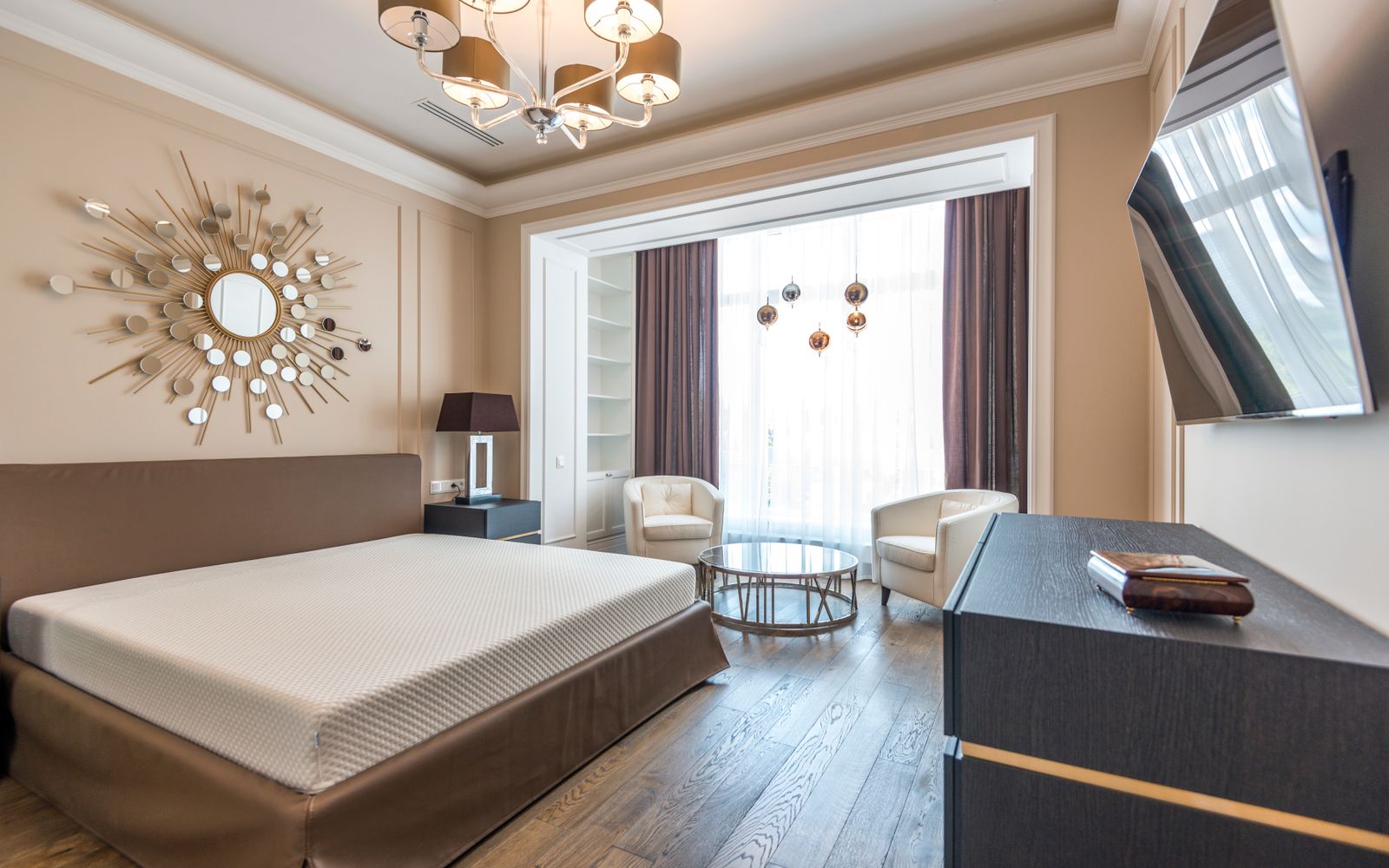
Stand in the doorway of a hotel guest room and count what you see, because hotel FF&E depreciation starts right here.
The king bed, the nightstands, the flat-screen TV, the carpet under your shoes, the drapes framing the window.
Each of those items runs on its own depreciation clock, and most of those clocks are far shorter than the building’s.
The bed might be a 5-year or 7-year asset. The walls around it are 39-year property.
That difference is where a big share of the tax benefit in hotel investing comes from.
A cost segregation engineer sees thousands of line items, each with its own recovery period.
My friends, let us walk through a hotel room by room and sort those items the way the tax code does.
What Is Hotel FF&E Depreciation?
FF&E stands for furniture, fixtures and equipment. In a hotel, it is everything a guest touches that is not part of the building’s structure.
Depreciation lets an owner deduct the cost of an asset over its useful life, as set by the IRS recovery periods.
Hotel FF&E depreciation simply means writing off those beds, desks, TVs and kitchen appliances over shorter lives than the building itself.
Hotels are nonresidential real property, so the building structure depreciates over 39 years.
Personal property inside the hotel is commonly 5-year or 7-year property, and land improvements outside are 15-year property.
The detailed rules live in IRS Publication 946, How to Depreciate Property.
Why Does Bonus Depreciation Change Everything?
The One Big Beautiful Bill Act (OBBBA), signed July 4, 2025, permanently restored 100% bonus depreciation under IRC §168(k).
It applies to qualified property acquired and placed in service after January 19, 2025, with “acquired” meaning the binding written contract date.
Bonus depreciation covers property with a recovery period of 20 years or less. That includes 5-year, 7-year and 15-year property.
It does not apply to the 39-year building structure.
So every dollar a study moves out of the 39-year bucket and into a shorter bucket can potentially be deducted in year one.
For the bigger picture, read 100% bonus depreciation is back and hotel investors stand to win the most.
“The building ages slowly. The furniture ages fast. Smart investors let the tax code follow the furniture.” — Vinney Chopra
The Guest Room: Where Hotel FF&E Depreciation Begins
Let us go back to that guest room. A typical select-service room is packed with short-life assets.
- Beds, mattresses and headboards are commonly 5-year or 7-year personal property.
- Case goods such as dressers, desks, nightstands and luggage racks are usually in the same bucket.
- Televisions, phones, safes and mini-fridges are commonly 5-year property.
- Carpet, when it is removable rather than glued as permanent flooring, is often treated as 5-year property.
- Drapes, blinds, lamps, mirrors and wall art are typically personal property as well.
The bathroom is more mixed. A removable vanity mirror may be personal property, while the plumbing inside the walls generally stays with the building.
Interior non-structural improvements made after the building is placed in service may count as qualified improvement property (QIP), which is 15-year property and bonus-eligible.
The Lobby and Public Spaces
Walk out of the room and down to the lobby. The story continues.
- Lobby sofas, chairs, tables, rugs and decorative lighting are commonly 5-year or 7-year property.
- Breakfast area tables, chairs, buffet equipment and coffee machines usually fall into the same group.
- Fitness center treadmills, bikes and weights are equipment with short lives.
- Decorative millwork and removable front desk features may qualify as personal property, depending on how they are attached.
Brand standards from Marriott, Hilton and IHG require regular refreshes, so hotels keep generating new deductions. Learn more in hotel PIPs and renovations as a recurring deduction engine.
Back-of-House: The Hidden Hotel FF&E Depreciation
Guests never see the back-of-house, but a cost segregation engineer studies it closely.
- Commercial laundry washers, dryers and folding equipment are commonly 5-year or 7-year property.
- Kitchen equipment like ovens, refrigeration, dishwashers and exhaust hoods serving that equipment often qualify as personal property.
- Specialty electrical and plumbing that serves specific equipment, rather than the building in general, may be reclassified to 5-year or 7-year property.
- Property management systems and IT hardware are commonly 5-year property.
The general electrical system that lights hallways stays 39-year. The dedicated circuit that powers the commercial dryers may not.
Exterior Items: The 15-Year Bucket
Now step outside. Land improvements are 15-year property, and they are bonus-eligible.
- Parking lots, curbs and sidewalks
- Landscaping, irrigation and fencing
- Swimming pools and pool decks
- Exterior site lighting
Signage, such as a freestanding monument sign, is commonly treated as personal property.
Remember, land itself is never depreciable. Only the improvements on it are.
What Stays in the 39-Year Bucket?
Not everything gets a short life. The building structure stays on the long clock.
That includes the foundation, framing, roof, exterior walls, windows, elevators, central HVAC, and general electrical and plumbing.
Interior improvements that enlarge the building, add elevators or change the internal structural framework do not qualify as QIP.
A good study separates these carefully. The IRS Cost Segregation Audit Techniques Guide shows what examiners look for.
Hotel FF&E Depreciation Table: Item by Item
Here is a simple summary of typical treatment. Actual classifications depend on the study and your CPA.
| Item | Location | Typical Recovery Period | Bonus Eligible? |
|---|---|---|---|
| Beds, mattresses, case goods | Guest room | 5 or 7 years | Yes |
| TVs, safes, mini-fridges | Guest room | 5 years | Yes |
| Removable carpet, drapes, lamps | Guest room / corridors | 5 or 7 years | Yes |
| Lobby furniture and decor | Lobby | 5 or 7 years | Yes |
| Breakfast and fitness equipment | Public areas | 5 or 7 years | Yes |
| Laundry and kitchen equipment | Back-of-house | 5 or 7 years | Yes |
| Dedicated equipment electrical/plumbing | Back-of-house | 5 or 7 years | Yes |
| Interior non-structural improvements (QIP) | Interior | 15 years | Yes |
| Parking lot, landscaping, pool, site lighting | Exterior | 15 years | Yes |
| Roof, walls, elevators, central HVAC | Building | 39 years | No |
A Hypothetical Worked Example
Let us put numbers on it. This is a hypothetical illustration with round numbers, not a real deal.
A syndication buys a hotel for $20 million. Land is valued at $3 million, so the depreciable basis is $17 million.
Hotel cost segregation studies commonly reclassify roughly 25% to 40% of depreciable basis. Assume 30% here.
30% of $17 million is $5.1 million moved into 5-year, 7-year and 15-year property.
If the hotel was acquired and placed in service after January 19, 2025, that $5.1 million could potentially be deducted in year one with 100% bonus depreciation.
The remaining $11.9 million stays 39-year property, roughly $305,000 per year on a full-year basis.
Without the study, the full $17 million would sit on the 39-year clock at about $436,000 per year.
For a limited partner, results flow through on the K-1. In Moneil-style syndications, year-one paper losses have commonly reached roughly 70% to 75% of invested capital. Results vary deal to deal, and nothing is promised.
For example, a $100,000 investment with a 70% paper loss shows $70,000. Used against $70,000 of passive income at a 37% federal bracket, that is about $25,900 of federal tax.
Compare property types in hotel cost segregation vs. apartments.
How Passive Investors Use These Losses
Limited partners in a hotel syndication are generally passive investors under IRC §469.
Passive losses offset passive income, such as other syndications, rentals or gains from selling passive activities.
Unused losses carry forward indefinitely and are released when you fully dispose of the activity.
They generally do not offset W-2 wages for a passive LP. See passive losses from hotel depreciation for details.
Also plan ahead for the sale. Depreciation on 5/7/15-year components is generally recaptured as ordinary income under §1245. Read depreciation recapture on hotel sales and how to minimize the sting of depreciation recapture.
Talk to your CPA before you invest, so the losses land where they can actually help you.
Frequently Asked Questions
Is hotel furniture 5-year or 7-year property?
It depends on how the study classifies it. Hotel FF&E is commonly treated as 5-year or 7-year property, and both are eligible for bonus depreciation.
Does bonus depreciation apply to the hotel building?
No. The building structure is 39-year nonresidential real property and is not bonus-eligible. Only property with a recovery period of 20 years or less qualifies.
Do I need a cost segregation study to claim hotel FF&E depreciation?
A detailed, engineering-based study is the usual way to identify and support short-life components. Learn more in how cost segregation saves accredited investors in taxes.
When does 100% bonus depreciation apply?
Under OBBBA, it applies to qualified property acquired and placed in service after January 19, 2025. Also see do hotels qualify for bonus depreciation.
Key Takeaways
- Hotel FF&E depreciation turns beds, TVs, carpet and equipment into short-life 5-year and 7-year assets.
- Exterior land improvements like parking lots and pools are 15-year property, and QIP is 15-year too.
- 100% bonus depreciation applies to these shorter-life items, not to the 39-year building.
- A cost segregation study commonly reclassifies 25% to 40% of a hotel’s depreciable basis.
- Passive LPs use these losses against passive income, and should plan for recapture at sale.
Before committing to any deal, learn how to evaluate a real estate syndication before investing.
If you want to explore how hotel investing could fit your tax strategy, I would love to talk with you.
Book your free strategy call with Vinney and join our Mastermind Family of accredited investors.
God bless you. Smile and Succeed. 🙏😊
Disclaimer: This article is for educational and informational purposes only and does not constitute tax, legal, or investment advice. Tax outcomes depend on your individual situation and the terms of each offering. Consult your CPA and legal advisors before making investment decisions. Offerings are available to accredited investors only. Past performance is not indicative of future results.
About the Author: Vinney Chopra is the founder and CEO of Moneil Investment Group and a 5x Amazon bestselling author. He arrived in America with $7 in his pocket and has since raised $250M+ across 36 full-cycle deals, helping accredited investors invest in hotel syndications. Learn more at AccreditedInvestor.blog or book a free strategy call.